Actus des entreprises
International Symposium on Planetary Health and the Cycles of Life at The University of Tokyo 2026
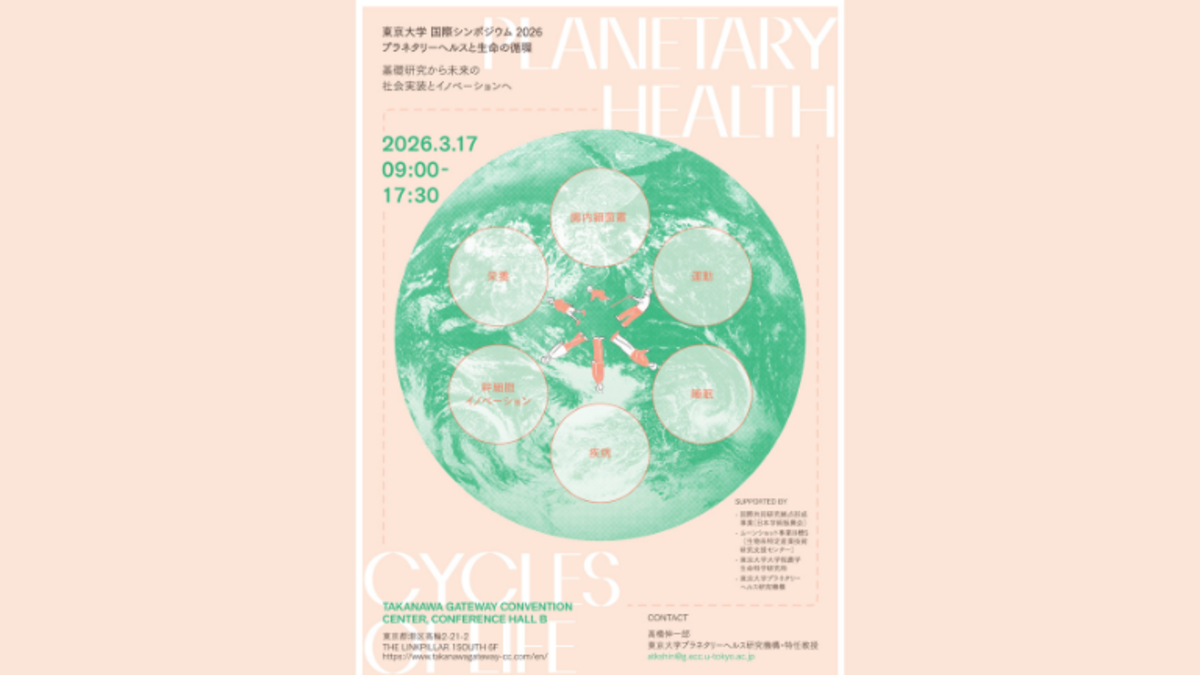
From Mechanistic Insights to Future Translation and Innovation
Purpose and focus
How should we live and work to reduce the burden on the planet?
Rethinking healthy life expectancy and working life as tools for environmental sustainability
Today, we face serious global challenges, including climate change, biodiversity loss, and shortages of natural resources. These problems are not only about energy or technology. They are also closely linked to how people live and how people work.
At the same time, advances in medicine, nutrition, and living conditions mean that people can live longer and stay healthier for more years than before. Until now, longer healthy lives and longer working lives have mainly been discussed in terms of personal well-being, social security, or labor shortages.
In this symposium, we take a different perspective.
We ask a simple but important question:Can longer healthy lives and working lives be used as tools to reduce the burden on the planet?
When illness and long-term care are concentrated in the later stages of life, society needs large amounts of medical services, care workers, materials, and energy. This places a heavy burden not only on society but also on the environment. If more people can stay healthy for longer, it may be possible to reduce these pressures and change how resources are used across society.
Working longer does not have to mean producing more and consuming more. It can also mean sharing knowledge, supporting others, caring for communities, and protecting nature. These are forms of work that contribute to society while using fewer resources.
This symposium explores practical ways to extend healthy life expectancy and working life while reducing environmental impact, focusing on the following themes:
- Food: Diets that are good for both human health and the planet
- Physical activity: Everyday movement to maintain health and prevent disease
- Sleep: Improving sleep quality to support mental and physical well-being
- Disease prevention: Preventing illness rather than treating it after it occurs
- Gut microbiota: Living in balance with the microorganisms in our bodies
- Stem cell biology: Science that supports functional health, not life extension at any cost
All of these approaches have the potential not only to improve individual health but also to reduce the demand for medical and care services and ultimately to lower the environmental burden.
This symposium brings together researchers, companies, policymakers, and people from many different backgrounds to think together about one key question:
What does a society look like where people can live long, healthy lives that are also kind to the planet?
By rethinking longer, healthier lives and working lives not only for individuals but also as a choice for the planet and future generations, this symposium aims to open new paths toward a more sustainable future.
For companies
This symposium explores a new idea: can longer, healthier lives help reduce environmental impact?
As climate change and resource limits become major business risks, companies are being asked to rethink not only energy and materials, but also how people live and work. Advances in health and life sciences now allow people to stay healthy and active for much longer. This symposium views healthy life expectancy and working life not as goals in themselves, but as tools for environmental sustainability.
By reducing the need for resource-intensive medical and care services, and by promoting low-impact forms of work such as knowledge sharing and community support, long healthy lives can become part of an environmental strategy.
Participation offers companies a chance to connect environmental, health, and human capital strategies in a single, forward-looking dialogue. If you can attend and support our activities, we would greatly appreciate it. If you are willing to support our networking, please contact the co-organizer, Dr. Anavaj Sakuntabhai (e-mail: anavaj.sakuntabhai@pasteur.fr)
Information
Date and Time: 9:00-17:30 on the 17th (Tuesday), March 2026 (17:30-19:30 Networking event)
Venue: Takanawa Gateway Convention Center Conference Hall A (https://www.takanawagateway-cc.com/en/)
Address: The Linkpillar 1 South 6F, 2-21-2 Takanawa, Minato-ku, Tokyo 108-0074, JAPAN
Support: International collaboration core-to-core program by JSPS, Moonshot project by BRAIN, Institut Pasteur du Japon, Embassy of France to Japan, and Graduate School of Agricultural and Life Sciences, and Research Institute of Planetary Health, The University of Tokyo
Contact on scientific event to:
Shin-Ichiro Takahashi, Research Institute of Planetary Health, The University of Tokyo, e-mail: atkshin@g.ecc.u-tokyo.ac.jp
Contact on Network event to: Anavaj SAKUNTABHAI, Institut Pasteur du Japon, e-mail: anavaj.sakuntabhai(@)pasteur.fr
Capacity: 200 people
・Simultaneous interpretation will be provided for science events
・A fee of ¥2,000 will be charged for the networking session (excluding students)