Interview
Business regards croisés - Danone: The HR challenges of foreign companies in Japan
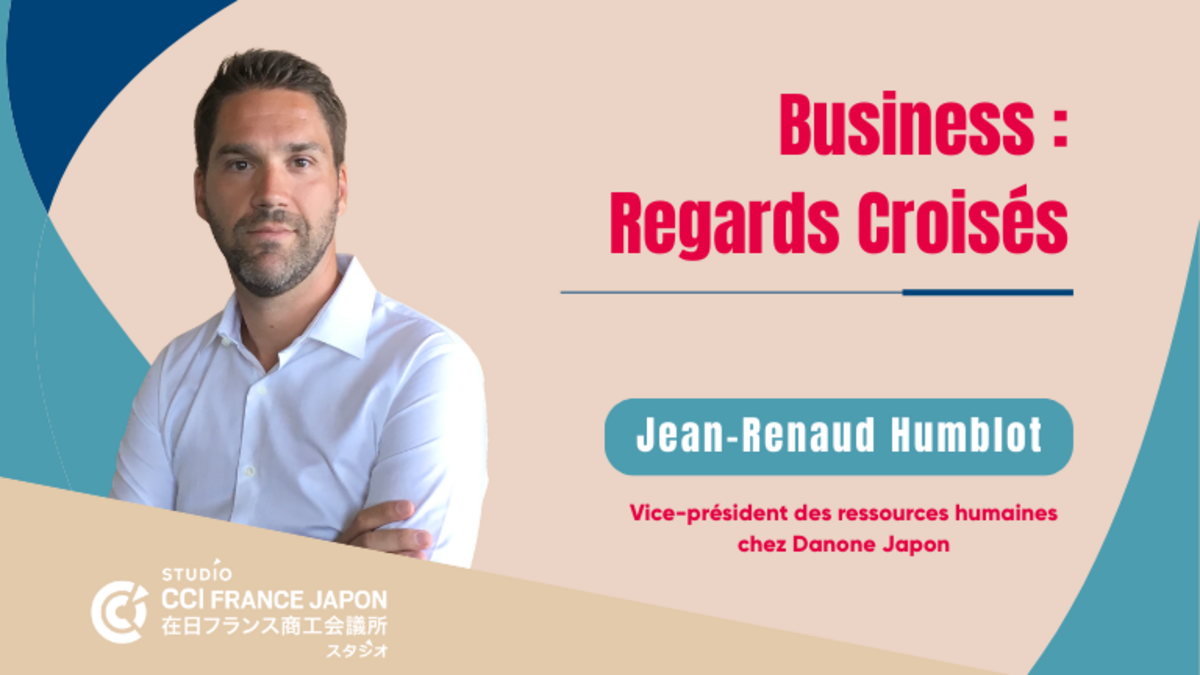
In this new episode of Business – Cross Perspectives, we meet Jean-Renaud Humblot, who joined Danone as HR Director for Japan and South Korea after six years in Australia and New Zealand. Leading human resources in a highly competitive environment, he shares insights into the challenges faced by foreign companies in Japan and the country’s strategic importance for the group.
“Japan is a Danone superstar”
Attracting talent in an ultra-competitive gaishikei market
For gaishikei—foreign companies established in Japan—the job market and talent management are extremely competitive. Indeed, looking for profiles that combine strong expertise with a good command of English immediately limits the pool of candidates. Talent with experience in multinational corporations (MNCs) represents only about 2% of Japan’s workforce. As a result, competition between companies for these profiles is particularly intense.
The loyalty of Japanese employees is often described as legendary. Even in a foreign company like Danone, some employees can reach 15, 20 or even 35 years of tenure. However, in the gaishikei environment, talents tend to have greater mobility as they can leverage competition between companies. Despite this, genuine loyalty remains, especially when employees identify with the company’s culture and values.
Reading between the lines: the intercultural challenge
When faced with communication gaps between French and Japanese professionals, one quickly notices that interactions in Japan tend to be less direct. It is therefore necessary to learn how to read between the lines and understand non-verbal signals. This cultural subtlety can sometimes be surprising.
Jean-Renaud Humblot notably mentions his discovery of taishoku daikō, agencies that handle employee resignations on their behalf.
When such situations occur, questions arise: at what point did dialogue break down? Why did the employee not feel comfortable enough to express their difficulties or discuss resignation internally? For HR teams, this highlights the importance of creating an environment built on trust and open communication.
Gender equality
Regarding gender equality in the workplace, Danone strives to support promotions and reduce pay gaps. Within Danone Japan, no salary gap has been observed between men and women in equivalent positions.
Women represent around 40% of managers, with an even higher proportion at headquarters, although the share is lower in factories. The company also ensures that maternity does not hinder careers. Beyond legal requirements, Danone offers 18 weeks of maternity leave and maintains salary progression during this period in order to preserve pay equality.
Japan’s place in the group’s strategy
The group operates in several segments: specialized nutrition, water, and dairy products. In the dairy segment, Japan is among the most successful markets worldwide. In 2025, Danone recorded its sixth consecutive year of double-digit growth in Japan.